I want you to sit with that for a moment. Because the implications are massive — and almost nobody I talk to in the Philippine business scene is thinking about this yet.
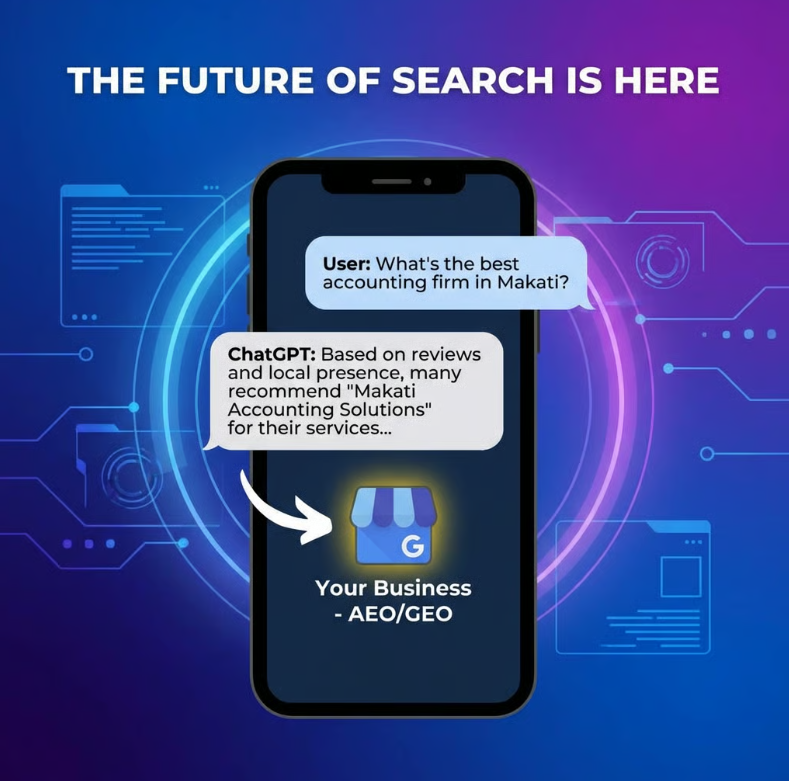
800 million people use ChatGPT every week. To put that in perspective, that’s roughly eight times the entire population of our country. And now, when someone types in “best accounting firm in Makati” or “where do I get my roof fixed in Cebu,” the answer won’t just be an answer anymore. It’ll come with an ad — matched to the conversation, matched to the intent, placed right there in the dialogue like it’s part of the recommendation.
How It Works
On January 16, 2026, OpenAI announced they’d begin testing ads for users on their Free and Go tiers in the U.S. The ads show up at the end of chats and are contextually matched to what the user was asking about. Ask about laptops, see a laptop ad that fits your criteria.
They built it around five principles: mission alignment, answer independence, conversation privacy, user control, and long-term value. The big promise? Ads won’t touch the organic answers. User data won’t be sold to advertisers.
Sam Altman had actually resisted advertising for years. But running large language models costs absurd amounts of money, and if they want to keep AI accessible at a global scale, the bill has to get paid somehow. Advertising is how.
This Isn’t Just “Google Ads But Inside ChatGPT”
Here’s where most business owners are going to get this wrong. They’re going to hear “ChatGPT ads” and think it’s just another platform to run campaigns on — like moving your Google Ads budget to a new channel. It’s not.
Think of it this way. For the last twenty years, digital advertising has worked like a palengke barker. You stand in the aisle, you shout louder than the guy next to you, and you hope someone walking by stops long enough to listen. That’s keyword bidding. That’s Facebook ads. You’re interrupting people and fighting for attention.
ChatGPT ads don’t work like that. They work more like a trusted friend giving a recommendation over coffee. The user is already in a conversation. They’re already asking questions, weighing options, thinking through a decision. And then — right there inside the flow — a recommendation shows up. It doesn’t feel like an ad. It feels like part of the advice.
That difference matters more than most people realize.
The Part That Should Worry You
Here’s the scenario I keep running through with business owners who come to us at SEO Hacker.
Imagine two restaurants in BGC. Both serve great food. Both have loyal customers. But Restaurant A spent the last year publishing detailed content — guides about their cuisine, the story behind their dishes, chef interviews, structured data on their site, FAQ pages that answer every question a potential customer might ask. Restaurant B just posted on Instagram and boosted a few Facebook ads.
Now someone asks ChatGPT: “Where’s the best place for Japanese food in BGC?”
ChatGPT pulls Restaurant A into the organic answer because it has quality, citable content — the kind that AI systems trust. Restaurant B doesn’t show up at all. Not in the answer. Not in the ads. Invisible.
And here’s the kicker: Restaurant A can now run ChatGPT ads on top of their organic presence. They’re the answer AND the sponsored recommendation. Restaurant B? They’d have to pay for ads just to show up in a space where their competitor already lives for free.
That gap gets wider every month you wait.
What AEO and GEO Actually Mean (In Plain Language)
I’ve been talking about AEO (Answer Engine Optimization) and GEO (Generative Engine Optimization) for a while now, and I know the terms can sound technical. Let me break it down simply.
AEO is about making your business the best possible answer to the questions your customers ask AI. When someone asks ChatGPT “how do I fix a leaking roof in Quezon City,” AEO is what determines whether your roofing company shows up in that answer or gets skipped entirely.
GEO is about structuring your content so that AI systems can actually find it, read it, and use it. You could have the best content in the world, but if it’s buried in an image, locked behind a login, or written in a way that AI can’t parse — it might as well not exist.
Together, they’re the difference between being part of the AI conversation and being left out of it completely.
SEO Isn’t Going Anywhere. It’s Actually More Important Now.
I need to address something because I know people will read this and think “so SEO is dead?”
No. Not even close. In fact, it’s more critical now than it’s ever been.
Here’s why. ChatGPT can shorten the top of the funnel. Someone can discover your business, compare you against competitors, and start leaning toward a decision — all inside one conversation. But they don’t just buy from a chat recommendation. That’s not how people work.
They still Google you. They visit your website. They read your reviews. They look at your portfolio. They check if you’re legit.
I see this all the time with our clients at SEO Hacker. A prospect finds them through one channel — could be social, could be a referral, could be a blog post — but the conversion almost always happens on the website. The website is still the closer. It’s still where trust gets confirmed and the deal gets done.
So think of it this way: AEO gets you in the room. SEO closes the deal. You need both. Dropping one for the other is like training your left arm and ignoring your right.
What You Should Be Doing Right Now
I know a lot of Filipino business owners reading this are thinking, “This is a U.S. thing. It won’t hit us for years.” I used to hear the same thing about SEO back in 2010. And the businesses that waited? They spent years playing catch-up against the ones that moved early.
ChatGPT doesn’t respect borders the way Google’s local search does. Your content gets surfaced — or ignored — globally. The playing field is the same whether you’re in Manila or Montana.
Here’s where I’d start:
Build content that AI can actually cite. Not 500-word blog posts stuffed with keywords. I’m talking about long-form guides, original research, case studies, and expert takes that give AI something real to work with. If your content doesn’t say anything worth quoting, AI won’t quote it.
Figure out what your customers actually ask before they buy. What are their objections? What comparisons do they make? What keeps them from pulling the trigger? Those questions are exactly what ChatGPT uses to match ads to intent. If you know the questions, you can be the answer.
Structure your content so AI can read it. Schema markup, FAQ sections, clear factual language. AI systems need structure. A beautifully designed website that’s all images and vibes but no parseable text is invisible to AI.
Double down on SEO. Your website is still where the conversion happens. Make sure it’s fast, trustworthy, and built to close. AI might bring someone to your door — but your site is what convinces them to walk through.
Rethink your metrics. Clicks and impressions won’t tell the whole story anymore. You need to start tracking whether AI is citing your brand, how your leads are finding you, and whether the quality of those leads is improving. The signals are changing. Your dashboard should too.
The Window Is Open. It Won’t Stay Open Forever.
Every time a new platform or channel emerges, there’s a window where the early movers get outsized returns. We saw it with SEO in the early days of Google. We saw it with Facebook ads before the algorithm got expensive. We saw it with content marketing before everyone started doing it.
AEO and GEO are in that window right now. The businesses that build authority in the AI layer today — before the ads become crowded, before everyone catches on — will have a head start that compounds over time. The ones that wait will be paying a premium to compete in a space where their competitors are already entrenched.
I’ve spent over a decade in SEO. I’ve watched trends come and go. This one isn’t going anywhere. The way people find businesses is changing at the most basic level, and the businesses that adapt early won’t just survive — they’ll lead.
The transition has started. The only question is whether you’ll still be visible when your customers stop Googling first and start asking AI instead.