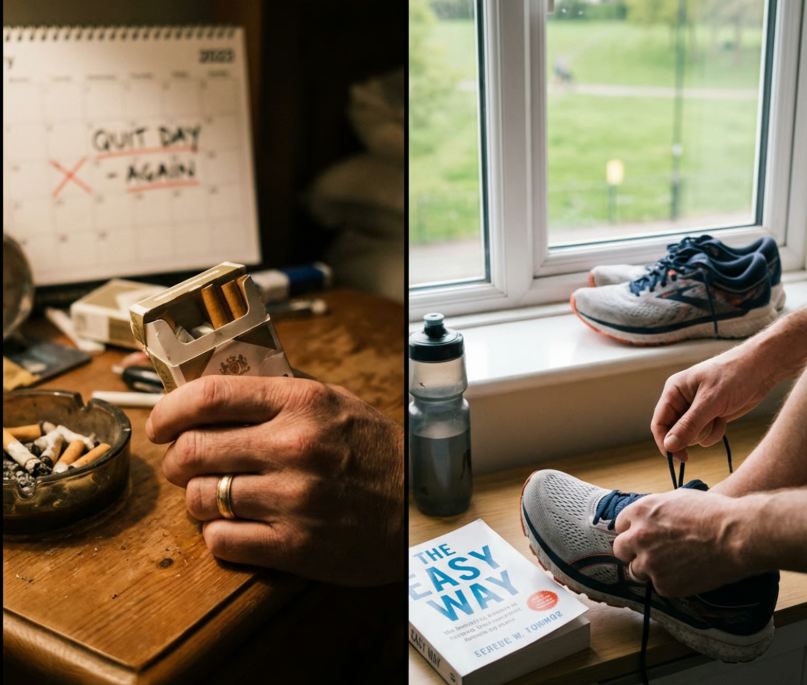
Every new year comes with the same hopeful energy:
“New year, new habits.”
We want to believe we’ll wake up on January 1 and suddenly become the disciplined version of ourselves—consistent, focused, healthy, and unstoppable.
But if we’re being honest… that’s not what usually happens.
And the reason is simple: old habits die hard.
Why Bad Habits Are So Hard to Quit
Think about smoking.
Everyone knows it’s harmful. It’s carcinogenic. It ruins health. It steals years.
And yet, it’s still incredibly hard to stop.
Why?
Because quitting a bad habit isn’t just about removing something.
It’s about dealing with what gets left behind.
The “Gap Problem”: The Real Enemy of Change
When you try to stop a bad habit, you create a gap—a space in your routine where that habit used to live.
And if you don’t fill that gap with something else, you won’t stay “free” for long.
Because the mind hates emptiness.
There’s a reason people say: an idle mind is the devil’s playground.
When you’re bored, stressed, restless, or emotionally off—your brain will pull you back to what’s familiar.
Even if what’s familiar is destroying you.
So the real strategy isn’t “stop.”
The real strategy is replace.
Replace Bad Habits With Good Habits (Example: Smoking)
If you’re trying to stop smoking, don’t just white-knuckle it and rely on pure willpower.
Instead, replace it with something that helps your body and mind reset.
For example:
- Take a walk when the urge hits
- Move your body
- Get sunlight
- Let your mind breathe
Walking helps reset your mental state, boosts mood, and does something powerful:
It turns a destructive loop into a constructive one.
You’re not just “quitting.”
You’re building.
Feelings Are Unstable — Systems Are Strong
Here’s another hard truth:
Most people fail because they rely on motivation.
But motivation is emotional.
And emotions are unstable.
You can feel ready today, and feel like quitting tomorrow.
That’s why relying on feelings is a weak plan.
You need a system.
A plan you follow even when you don’t feel like it.
A routine that carries you when your emotions don’t.
Habit Chaining: The Simple Way to Stay Consistent
One practical approach that works: habit chaining.
You decide:
- “When I wake up, I do this.”
- “After that, I do this.”
- “Then I follow it with this.”
It’s not magic. It’s momentum.
And once momentum starts, it becomes easier to stay on track—because you’re no longer negotiating with yourself every hour.
The Power of an Anchor Habit
If there’s one thing that makes habit-building easier, it’s this:
Have an anchor habit.
An anchor habit is the one habit that, once you do it, helps your whole day fall into place.
For me, one of those anchor habits has been cold plunging.
When I do it, it’s like the rest of the day follows.
It sets the tone. It locks me in. It tells my brain: We’re serious today.
Now, your anchor habit doesn’t have to be cold plunging.
It can be:
- a short walk
- prayer/devotion time
- journaling
- a quick workout
- reading a few pages
- making your bed
- drinking water first thing
The point is: choose something you can reliably do—then chain the rest of your habits behind it.
Happy 2026
Here’s what I hope for you this year:
Not just “new goals.”
Not just “new motivation.”
But good habits built with a real system—so you can actually keep them.
Happy 2026 🙂
Build the habits that build you.